

White Paper
The Intelligence Gap: Why AI in Legal Isn’t Delivering and What Needs to Change
This report examines why AI in legal is widely deployed but not yet delivering.
White Paper
Strategies for legal teams to cut external costs and scale in-house capability with AI and data.
Corporate legal departments—especially across Asia Pacific—are facing increasing pressure to deliver more value with fewer resources. Despite operating within a rapidly growing legal services market, legal teams must manage rising workloads, tighter budgets, and heightened expectations from the business.
In response, many organisations have begun modernising their legal operations, focusing on improving visibility, controlling costs, and adopting emerging technologies such as AI. However, the challenge has shifted from whether to transform to how to do so effectively—without disrupting critical work.
This paper explores how legal leaders can strengthen in-house effectiveness by reducing reliance on external spend, optimising resourcing models, and embedding scalable capabilities. It outlines the transition from foundational transformation to measurable impact, highlighting the growing role of AI, data-driven decision-making, and operational discipline in delivering sustainable results.
Morae research with 850 senior legal leaders shows the problem is implementation, not the technology. Fragmented data, weak governance and heavy human correction consume the efficiency gains AI was meant to deliver.
The verification tax is the cost of humans checking and reworking AI outputs. In the 2026 AI in Legal Report, 67% of legal leaders fear this cost outweighs the benefits of AI and 48% must materially change outputs before use.
Unified Legal Intelligence is a legal function in which AI is contextually aware, works across the whole legal function, produces decision ready outputs and compounds in value as data and context accumulate.
White Paper
This report examines why AI in legal is widely deployed but not yet delivering.
White Paper
Why document management must evolve into a governed, integrated layer enabling AI and legal value.
White Paper
Legacy case management systems come with hidden costs that impact efficiency, compliance, and scalability.

White Paper
Discover how to move from policies to practice—and make compliance a shared mindset across your organization.
White Paper
Implementing the iManage document management system in a secure, compliant and fully managed cloud environment
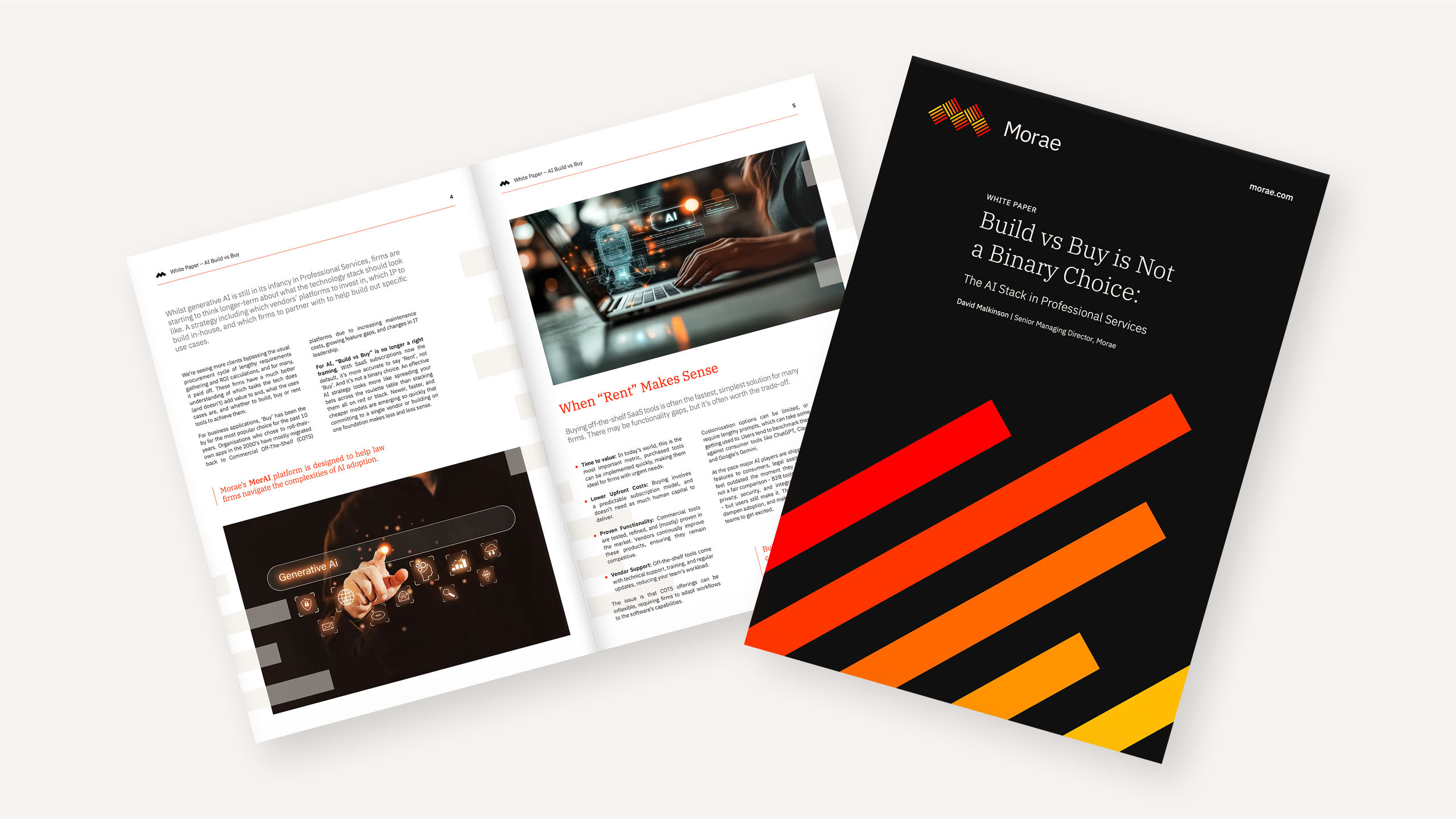
White Paper
Firms increasingly face a pivotal decision—should they build their own AI solutions or buy them off the shelf?

White Paper
Learn how we helped cut client costs by 75% and meets a one-week deadline with Relativity aiR for review

White Paper
Legal leaders' top 2025 priorities: AI adoption, spend management, and balancing innovation with integrity.